01Explore local resources
Step into the rice field
The young participants joined rice planting in Sasabe. Seeing the work behind rice growing was their starting point.
Sasabase activity · Sixth-Sector School
From the rice field to the market.
Young people have planted rice and developed a rice-flour cookie. Explore the first cohort's work before its October sales and review.
See the first cohort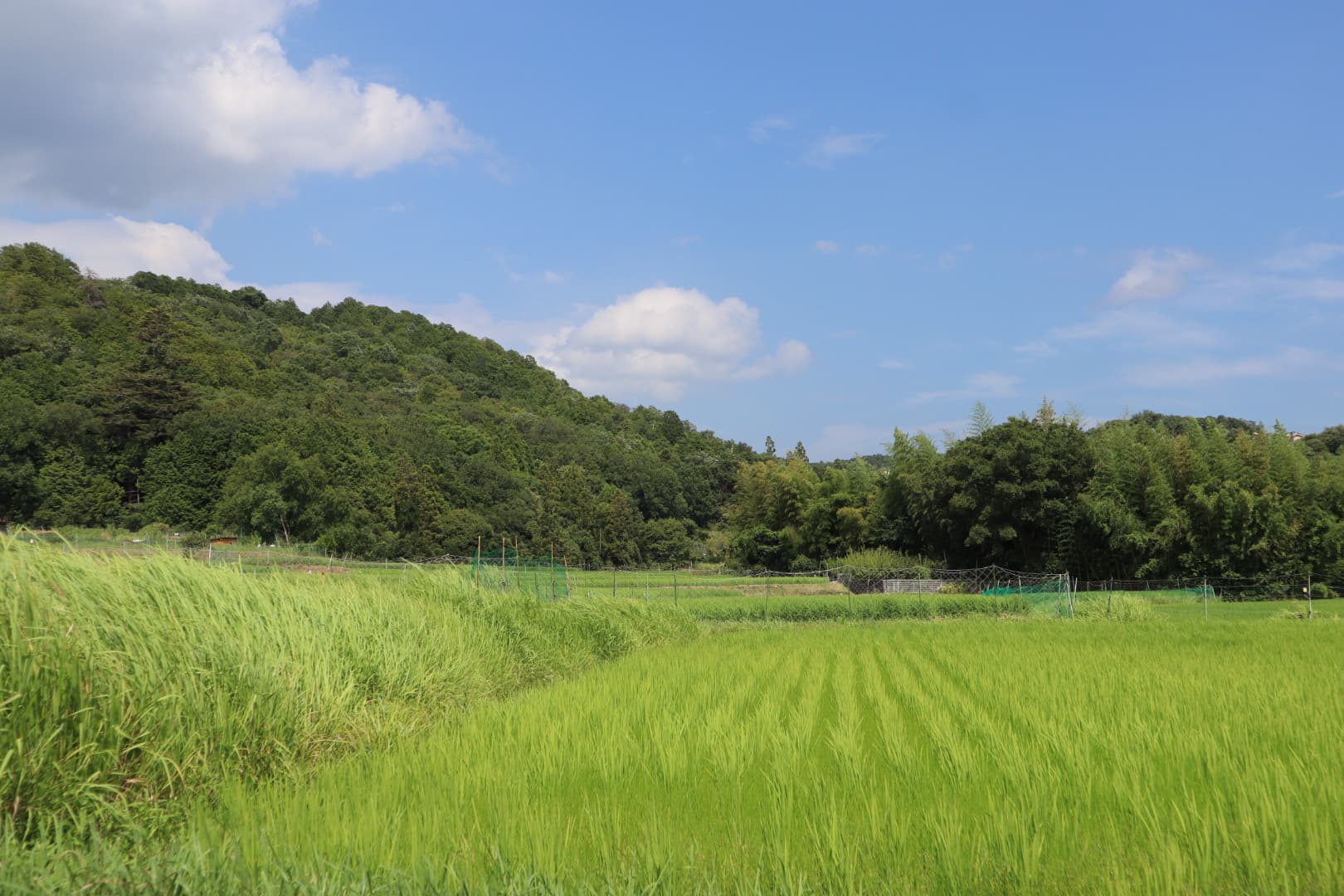
Production × Processing × Sales
Whole-community campus
The first cohort in Sasabe
Young participants have worked with local people and businesses, from rice planting to developing a rice-flour cookie. Product planning, costing, outsourced production and pricing are complete. Sales are planned for 4 October, followed by a sales tally and closing ceremony on 17 October.
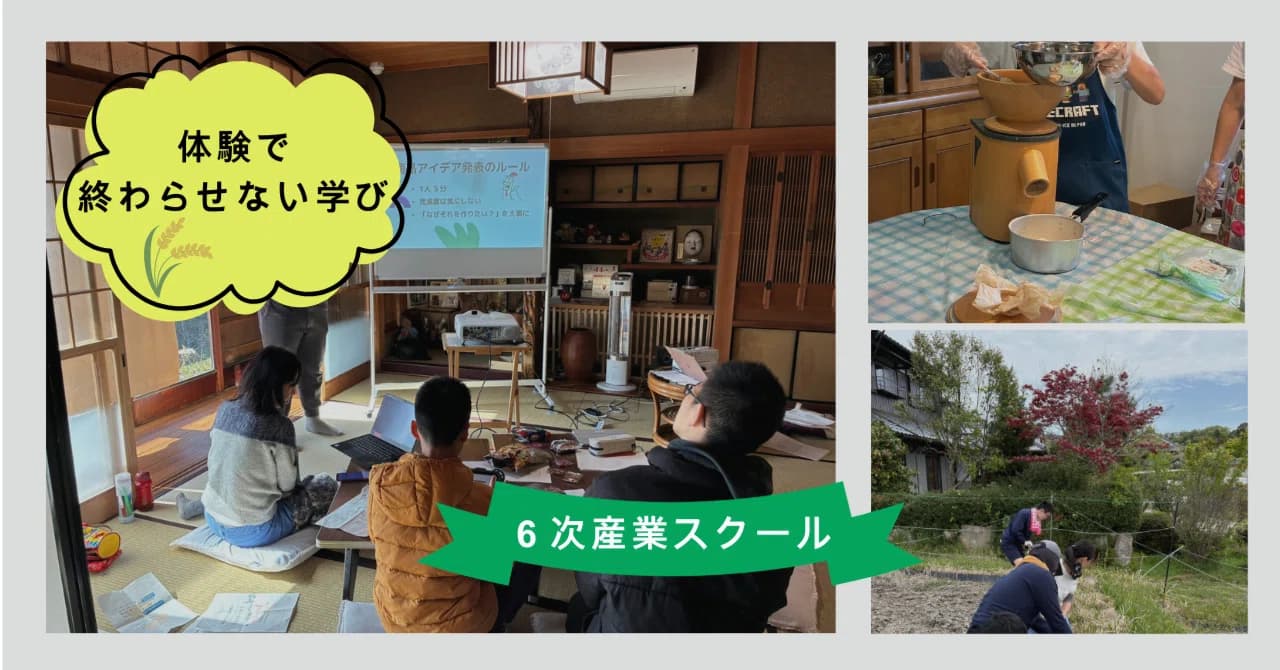
The young participants joined rice planting in Sasabe. Seeing the work behind rice growing was their starting point.
They developed a rice-flour cookie, considered its customers and marketing, and completed costing, outsourced production and pricing.
Sales of the finished cookies are planned for 4 October 2026. The group will tally the sales and hold a closing ceremony on 17 October.
Hands-on activities vary with the season and the timing of each programme.
About the programme
In Japan, “sixth industrialization” refers to connecting primary production, secondary processing, and tertiary sales or services — 1 × 2 × 3 = 6. The aim is to create new value from local resources.
At Sasabase, the work in the rice field, product planning, collaboration with processors, and selling are treated as parts of one connected challenge.
Which tasks participants can do in person depends on the season and the timing of the programme. At every stage, they consider how a local resource becomes something valuable, and who it is for.
It is practical learning shaped with local people and connected to real economic activity.
Why learn here?
The terraced paddies of Sasabe are actively farmed land that still needs tending. This is not agriculture staged for visitors, but practice within the reality of the local community.
Farmers are ageing and the shortage of successors is serious. Getting involved in this challenge means experiencing learning that flows back into the region.
You engage directly with the farmers, processors, and retailers who sustain the local economy. You encounter real decisions and values that no textbook contains.
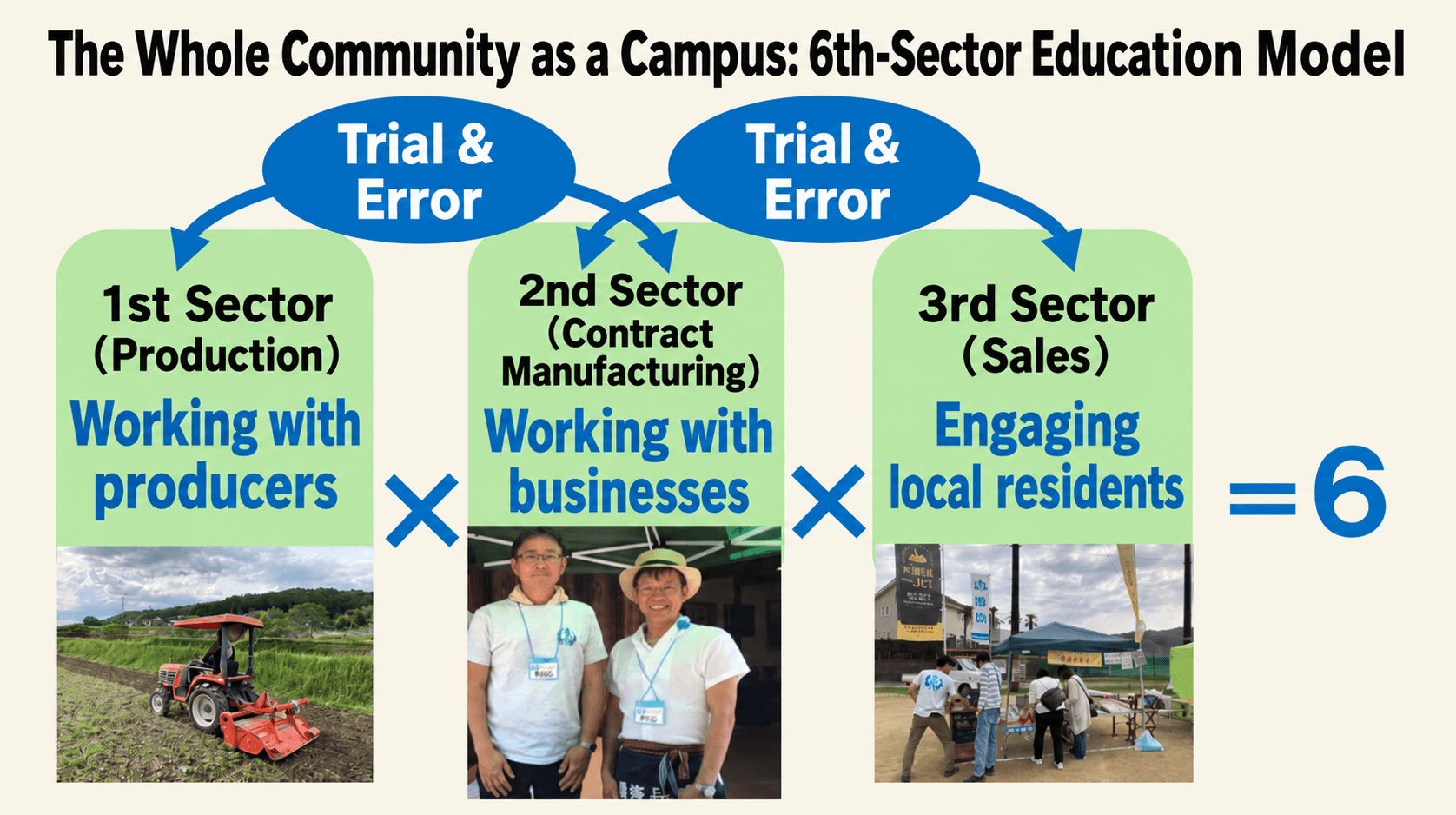
Sasabase is an experiment in the “whole-community campus” model.
In this model, you engage with many different people. With producers at the growing stage, with businesses at the processing stage, and with local residents at the selling stage.
It will not go smoothly. Through repeated failure and success, you experience and learn what 1 × 2 × 3 = 6 truly means.
Learning flow
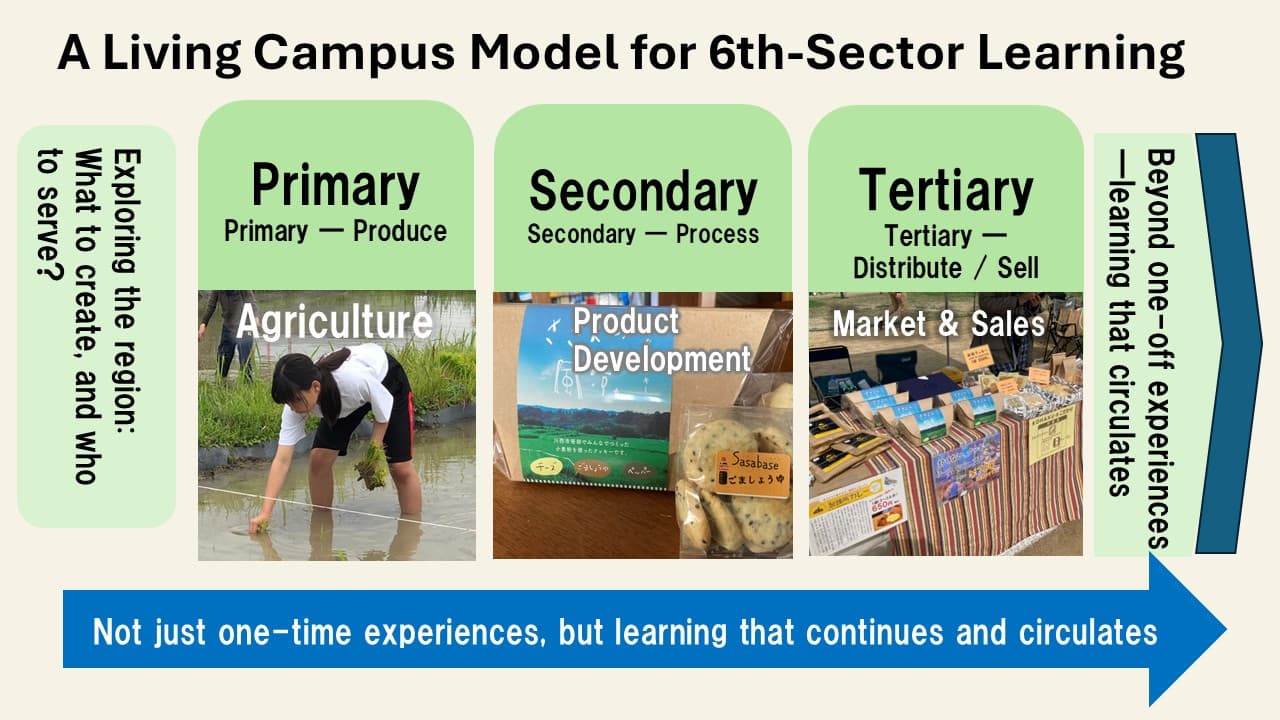
The three phases of production, processing, and selling are each independent areas of learning — and at the same time, they are deeply connected.
By going through the entire sequence, you develop the ability to think about how value is created.
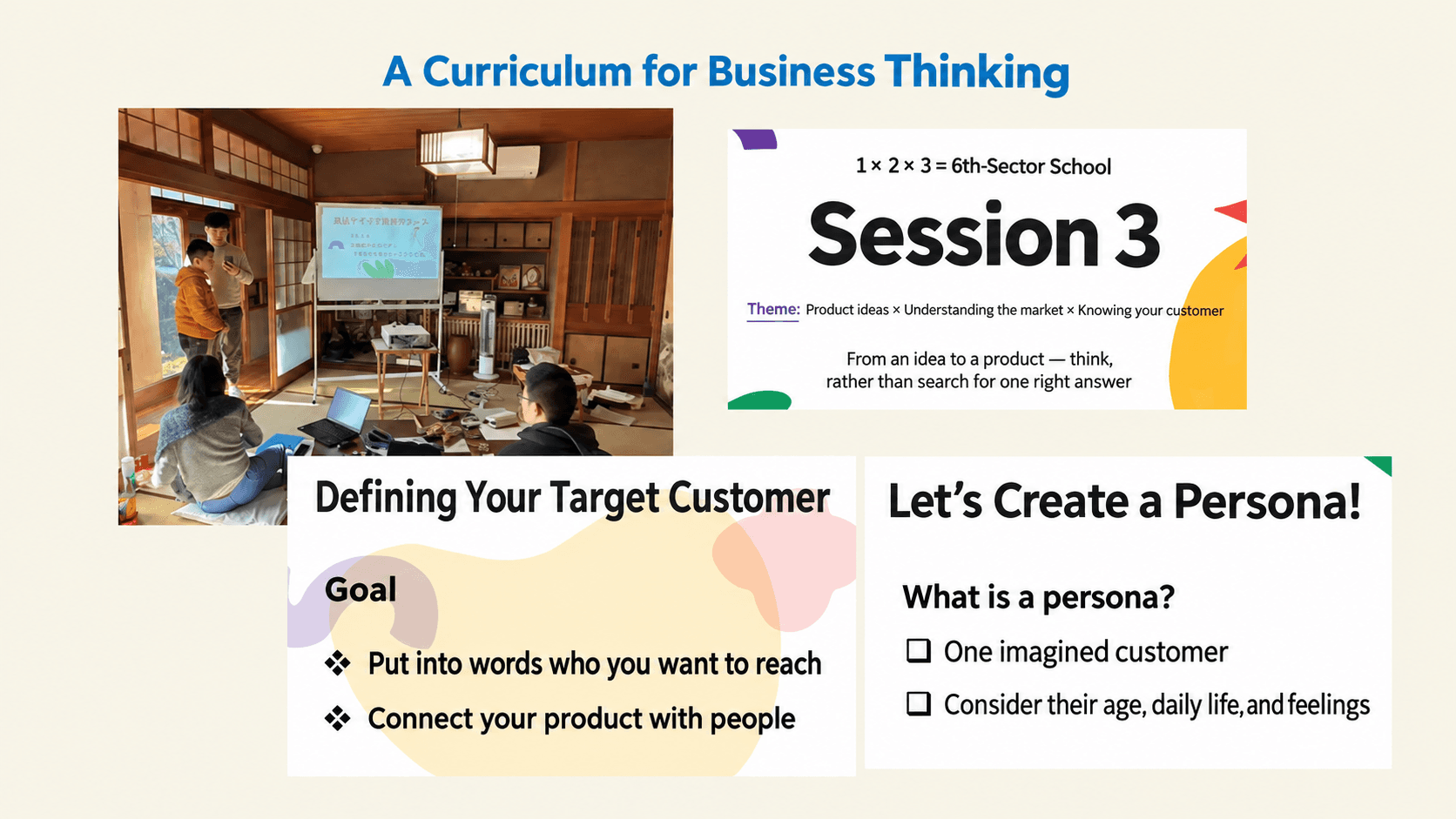
※ What you can experience on-site depends on the timing of your participation and the programme design.
Primary
Learning involves taking part in the year-round cycle of rice cultivation. What you can join depends on the timing of your participation — from preparing the soil to managing water to harvesting. You begin by encountering the weight of what it means to grow food.
Secondary
You think about what products could be made from rice and other local ingredients. The learning goes beyond processing methods to include how to draw out the qualities of the material and who to deliver it to. Depending on the programme, you may also take part in actual processing work.
Tertiary
There are actual sales settings, such as local markets. Where timing allows, you join the real selling floor and face the facts of what sold and what did not. Even when you cannot attend in person, you think through the questions of who to reach and how, using real local examples.
Through these three phases, you come to understand — as your own practice — the process by which local resources are transformed into value.
How to get involved
This kind of learning cannot be completed in a single day's experience. The essence only becomes visible through involvement that spans the seasons — from soil preparation to selling.
Individuals, students, and corporate teams can all participate in different ways. By working alongside local people and businesses, perspectives and relationships emerge that could not be generated alone.
The shape of the programme is designed together with you, based on your objectives and situation.

Enquiries
We design each Farm-to-Market Learning programme through an individual consultation. Because the content varies depending on your objectives, duration, and level of involvement, please feel free to reach out first.
We welcome enquiries even at the idea stage — “I wonder if something like this might be possible.”
※ Depending on availability, there may be a waiting period.
Contact us
Contact
A practical learning programme connecting education with local livelihoods and markets.